

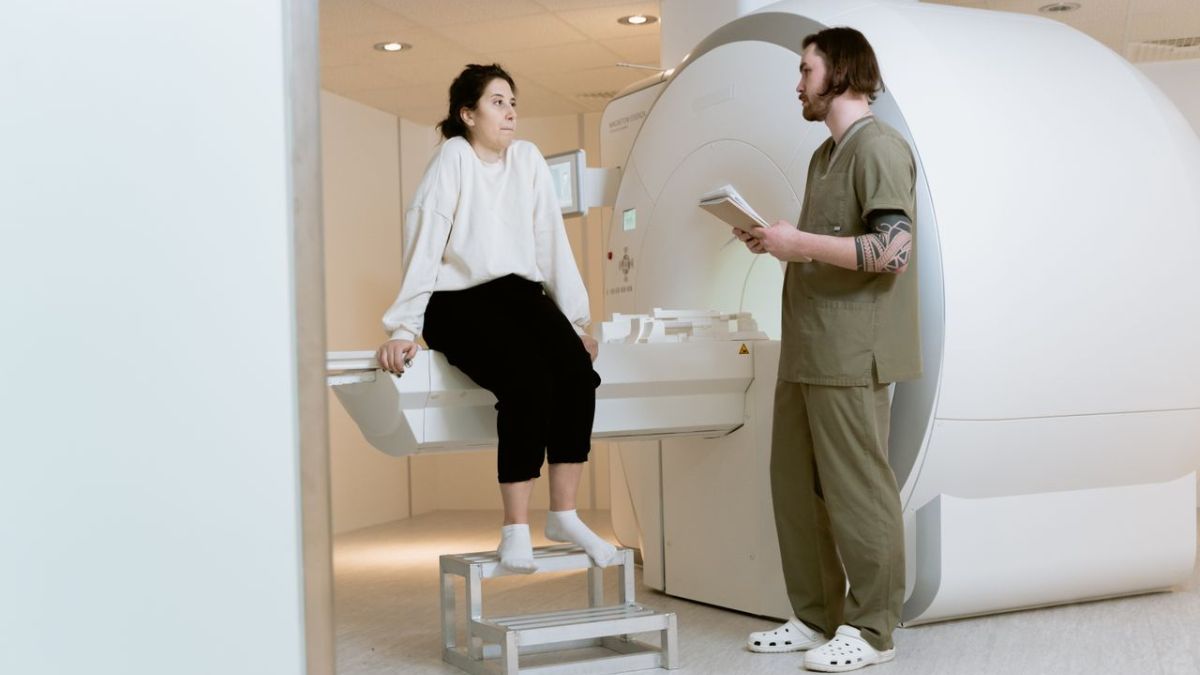
Doctors working on the first non-invasive diagnostic test for endometriosis have published the results of the DETECT phase 2 clinical trial, and the news, according to the researchers, is good. Clinical trial results hint that women might soon be able to opt for an endometriosis scan instead of a surgery.
This April, Oxford University, UK, based gynaecologists reported in the Lancet Obstetrics, Gynaecology & Women’s Health, that they can now consistently identify endometriosis lesions using existing medical imaging equipment, available in most radiology departments.
Researchers have developed a way to label endometrium-like growths outside the uterus using a small molecule called maraciclatide. This is the first imaging technique that has shown sustained results, correctly pinpointing endometrial lesions without surgery. Read more about how maraciclatide works here.
An Upgrade for Endometriosis Care Without Upgrading Equipment
In the paper, Dr Tatjana Gibbons describes how she and her colleagues at Nuffield Department of Women’s and Reproductive Health, University of Oxford and the Oxford Endometriosis CaRe Centre successfully used maraciclatide attached to the radiotracer, Technetium-99m to detect endometriosis with comparable results to laparoscopic investigation. Gibbons explained in a press release, ‘These exciting findings indicate that maraciclatide offers a highly promising diagnostic and monitoring tool, particularly for superficial peritoneal endometriosis, which is the most common and yet the hardest type of endometriosis to identify.’
Phase 2 clinical trials test whether a new treatment or procedure works and if it’s harmful in a small carefully controlled environment. It’s a necessary step to complete before doctors can organize a larger, more rigorously controlled, phase 3 clinical trial to assess how well the intervention works and if it’s as good or better than existing methods.
The Oxford researchers, overseen by Dr Christopher Becker and Dr Krina Zondervan, co-directors at the Oxford Endometriosis CaRe Centre, set out to test whether maraciclatide labelled with Technetium-99m could correctly identify endometrial lesions in women with endometriosis. So how did the clinical trial work out for this novel endometriosis scan?
Encouraging Results for Endometriosis Scan in Clinical Trial
The results of the trial were, as Gibbons says, exciting. Once women had gone through the SPECT-CT scans, the team’s radiologists were able to detect endometriosis lesions with ‘near surgical precision’, according to the authors, reporting a success rate of 82%.
Not only, they say, were the radiologists effective in spotting the most common type of endometriosis – superficial peritoneal endometriosis lesions – but also in successfully identifying less common ovarian and thoracic endometriosis lesions.
Dr Krina Zonderman, who co-directed the study, highlights the significance of these findings. ‘Superficial peritoneal endometriosis, the most prevalent subtype of endometriosis, currently evades reliable detection, leaving women no choice for diagnosis other than invasive surgery.’ She continues, ‘If these results are confirmed in larger Phase 3 studies, imaging with maraciclatide could transform clinical research and practice and potentially empower the development of treatments for women across the globe.’
Of the 19 women who completed the study, surgeons found endometriosis lesions in 17. Surgeons classified the other two women as endometriosis negative based on surgical results. There were no maraciclatide false positives. The researchers did, however, report that the radiologists missed three of 17 surgically confirmed endometriosis cases, resulting in a sensitivity of 82%. In other words, the radiologists could not distinguish maraciclatide labelled lesions in three cases that were surgically confirmed as positive for endometriosis.
Scan vs Surgery
How did the researchers test maraciclatide SPECT-CT? By directly comparing it to surgical results. Twenty women who were already due for a laparoscopy to test for endometriosis were recruited for the study. A laparoscopy is a surgical procedure that involves insertion of a small camera into the abdomen. The surgeon will probe the abdominal cavity in search of endometriosis lesions taking photos or video and sometimes biopsies as they go. This is currently the only way to make a definitive diagnosis of endometriosis.
Participants voluntarily received maraciclatide-Tecnetium-99m through IV infusion and were imaged with a SPECT-CT scan two to seven days before their scheduled surgery.
Radiologists and surgeons examined the results from the scans and surgery, respectively. Once the doctors had tallied up the number and location of lesions, they compared notes to see how well they matched up. Did the radiologists and the surgeons agree?
Non-invasive Endometriosis Test Nearly As Good as Surgery
In 17/19 cases, surgical observations confirmed the presence of endometriosis lesions in the women who completed the study. The radiologists managed to discern lesions in 14 of those 17 women. Like the surgeons, the radiologists saw nothing that would suggest a lesion in the two women who did not have endometriosis.
The authors also noted that the radiologists also spotted lesions that are typically difficult to find. The SPECT-CT scan was able to detect endometriosis lesions in women who were receiving hormonal therapy to shrink lesions. This was a remarkable finding, since this treatment often makes lesions undetectable. In the real world, many women with endometriosis use hormone treatments to manage their symptoms; in fact, so were half of the women in the trial. If doctors can use SPECT-CT to image even these tiny lesions, it adds a new dimension to the utility of this technology.
It is important to note that the scans and reports that the radiologists and the surgeons were not blinded. The surgeons and radiologists seem to have worked together to interpret the results so they may well have overestimated the test sensitivity. On the other hand, this is a phase 2 trial intended to provide evidence that this imaging technique merits a phase 3 trial, so it doesn’t necessarily cast a pall on the results.
Phase 3 Clinical Trials for Non-invasive Endometriosis Test in the Works
Doctors plan to start an international, multicentre phase 3 clinical trial late 2026. Dr Christian Becker, who co-supervised the project, explained, ‘If these Phase 2 results are reproduced in the Phase 3 studies, maraciclatide has the potential to be an extremely valuable tool, as it could both reduce diagnostic delays and provide a validated endpoint for the development of new therapeutics.’
Endometriosis affects hundreds of millions of women worldwide, yet the only definitive diagnostic is a surgical investigation. Other diagnostic tests do not detect endometriosis lesions. They provide circumstantial indirect evidence that a woman probably has the condition. Many women are not referred for surgery because healthcare providers may not suspect endometriosis, as its symptoms can be either highly specific – such as infertility and pelvic pain – or nonspecific, including fatigue and bloating. Surgery is expensive and, like all procedures performed under anaesthetic, involves a level of risk. Doctors will want to be sure a woman likely has the condition before adding her to a long waitlist. Combining all these variables, getting a diagnosis of endometriosis can take as long as 8–12 years.
With these phase 2 trials wrapped up and phase 3 trials upcoming later this year, the prospects for a non-invasive endometriosis scan appear to be pretty good.
A final word from Dr Tatjana Gibbons reminds us what’s most important in this trial: ‘We are hugely grateful to the patients who have participated in the DETECT study without whom investigating this diagnostic approach would not have been possible.’
Read the full study:
Gibbons T, Ghesani M, Burch D, et al. Assessment of endometriosis angiogenesis using 99mTc-maraciclatide imaging (DETECT): a single-centre, exploratory, open-label, non-randomised, phase 2 study. The Lancet Obstetrics, Gynaecology, & Women’s Health. 2026;0(0). doi:10.1016/S3050-5038(26)00048-8
