

Updated ,first published
New York: Prime Minister Anthony Albanese has dismissed the US government’s public criticism of his plans to overhaul social media algorithms and regulate perceived harmful content, putting him at loggerheads with United States President Donald Trump.
The Trump administration issued a scathing statement on Tuesday afternoon (AEST), arguing the attempt to tackle social media harm announced earlier this month would likely to result in censorship and would disproportionately hit American companies.
Speaking to reporters in Manhattan, Albanese said he would not back away from prosecuting Australia’s interests.
“The digital duty of care is something that we’ve foreshadowed for some period of time,” he said.
“It’s not about giving government control; it’s about giving people back control over what they receive on their devices, which is why it is framed in that way.”
The US is particularly concerned by “potential mandates that would allow regulators to impose rigid, one-size-fits-all platform design requirements – such as forced chronological feeds or opt-in recommendation systems”.
It requested the Albanese government “withdraw any plans to mandate that platforms algorithmically suppress content based on ambiguous government-defined safety criteria”.
Issued by the US embassy in Canberra, the American response to the bill’s exposure draft came just as Albanese is in New York to speak at the United Nations, where he spruiked on Australia’s leadership in technology regulation.
In his speech to the UN, Trump also rejected what he called a “globalist scheme” to regulate AI – which Australia has joined – and said the US would officially rename artificial intelligence to “super intelligence” in a bid to rehabilitate the concept’s image.
Albanese said there’s a recognition that technology could bring enormous benefits, but the international community needed to “make sure that humans are in control.”
Albanese did not answer a question on whether he would refer to the technology as “super intelligence” instead of artificial intelligence, a push Trump has made to rehabilitate the concept’s image.
On the duty of care, the Trump administration has asked Australia to clarify how it would determine what constituted online harm, warning that vague definitions risked becoming a mechanism for “viewpoint-based censorship”.
Platforms were likely to over-moderate speech to avoid penalties of up to $109 million, the US concluded, leading to censorship of controversial views.
“Such a framework also risks reducing the reach of independent journalists or other voices whose content touches on sensitive or controversial topics that platforms may preemptively demote to comply with overbroad safety mandates,” the US government said.
It added that if the Australian government compelled platforms to filter content in algorithmic feeds, and that filtering drew in “protected speech”, then the impact would be materially indifferent to the government simply removing such speech from the platform.
“The US government would likely consider such a measure as facilitating censorship,” it said.
“The US government has made clear its opposition to foreign measures that result in extraterritorial censorship of protected speech by Americans online.”
The US noted the majority of online platforms affected were American-owned and global, and that mandatory design features would likely impact content seen by users outside Australia.
If other countries adopted their own duty-of-care mandates, platforms could face incompatible design requirements “that are not technically or commercially scalable”, the US said. The most restrictive policy would likely win, it added.
The statement is the first substantive US government response to the proposed digital duty-of-care regime, which had already caught the eye of the big tech firms and their lobbyists in Washington.
Under the changes, social media platforms will be required to protect under-18s from harmful content, with the government pointing to material that encourages eating disorders, glorifies crime or promotes “hostile ideas about women and gender equality” as examples.
The platforms will also be compelled to send a notification to new and existing users offering them a choice over their default feed. They will be able to opt out of receiving content recommended by an algorithm and only receive content shared by creators they choose to follow.
Communications Minister Anika Wells billed the reforms as a “global reckoning” on big tech, and the next step following Australia’s social media ban for under-16s.
When he announced the regime earlier this month, Albanese countenanced resistance in the US, but said Australia was a sovereign nation, and the government would make policy in Australia’s own interests.
“It’s not about censorship. It’s about giving people control themselves over what they see,” the prime minister said at the time.
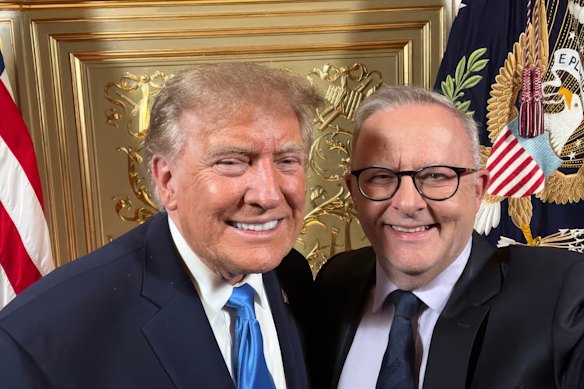
Albanese is due to attend a UN leaders’ reception with President Donald Trump and other world leaders at the Lotte Palace Hotel in Manhattan on Tuesday evening (New York time), before addressing the UN General Assembly on Thursday.
The US statement – issued by its embassy in Canberra – landed only days after Trump’s new envoy to Australia, David Brat, arrived to take up the post.
Feedback on the exposure draft closed on Tuesday.
Read more on US politics:
Get a note directly from our foreign correspondents on what’s making headlines around the world. Sign up for our weekly What in the World newsletter.
 Michael Koziol is the North America correspondent for The Age and Sydney Morning Herald. He is a former Sydney editor, Sun-Herald deputy editor and a federal political reporter in Canberra.Connect via X or email.
 Rob Harris is the national correspondent for The Sydney Morning Herald and The Age based in Canberra. He is a former Europe correspondent.Connect via email.