

Nathan Risser and Will Kubzansky
Passengers on a luxury ship touring the world have been told their unexpected final stop is Cambodia after the cruise company suspended operations, citing “extraordinary” fuel costs.
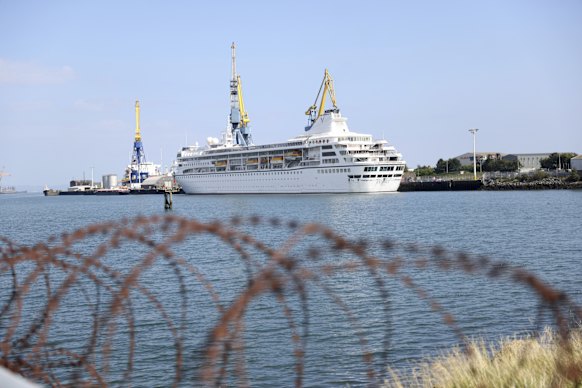
Florida-based Villa Vie Residences’ 650-passenger ship Odyssey is now moored in Sihanoukville, Cambodia, and the company “is working with residents to co-ordinate disembarkation and identify temporary living arrangements”, according to a statement on Wednesday AEST.
While the company is covering lodging and local transportation, it hasn’t provided funding for passengers to depart the country, Villa Vie Founder Mikael Petterson said in a telephone interview. About 200 residents were on board when the disembarkation was ordered, he said.
Fuel costs for the company have risen over 300 per cent since the start of the US-Israel war on Iran, Villa Vie Residences said, making the “current operating model extremely challenging”. Per-cabin fuel costs, which have historically averaged about $US1800 ($2557) a month, surged to $US6000 to $US8000, it said.
Passengers baulked at a request to chip in to help cover the cost of fuel to depart Cambodia, Petterson said. The company is now proposing that passengers pay roughly $US500 more a month, in addition to a fuel surcharge, as long as prices remain elevated, he said. The company is also seeking financing to depart the area “quite quickly”, Petterson added.
Odyssey has been at sea since October 2024, and it’s not like a typical cruise line. Its passengers either rent, own or rent-to-own cabins on the ship. According to a brochure, cabin prices for permanent residency range from just under $US130,000 to $US440,000 for a suite, with monthly fees of $US2000 to $US10,000.
The vessel departed Belfast, Ireland, for a “continuous” voyage around the world, according to the company’s website. It’s unclear where stranded passengers and staff will go after disembarking in Cambodia. The company press release said it “recognises that this is a difficult and disruptive period for residents, crew members, and employees”.
Fuel costs have lifted monthly operating costs by about 50 per cent to $US3 million, Petterson said.
“When the war broke out, nobody expected that war to carry on,” he said. “Everyone saw what happened in Venezuela; it was a hit and run … if you asked anyone, they expected fuel to be elevated for a month, a few months. When the ceasefire came, that was expected to be the end of it. Now, if you look at what the analytics say, we don’t see the end of this until Trump is out of power.”
Travel costs – whether by plane, car or ship – have surged since the Iran conflict spiked the price of oil and the products made from it, including diesel, petrol and jet fuel. Those elevated costs are hitting companies’ bottom lines, feeding into inflation and rippling through the global economy.
The marine gas oil that powers the Odyssey has surged to $US1339 a metric ton in Singapore, compared with about $US700 before the war.
Odyssey has stopped in ports from Tonga to Australia this year and, according to its itinerary last updated eight days ago, was due to end 2026 in India.
“As you flip through these pages, envision yourself sailing on a continuous odyssey where every day promises new horizons, cherished memories, and heartfelt connections,” the brochure says.
Since the Iran War began, the ship has tried to reduce fuel consumption by slowing its itinerary and spending more time in port, but the measures did not offset fuel costs, it said. The company is now evaluating restructuring and recapitalisation alternatives over the next sixty days.
“The company cannot simply pass increases of that scale on to residents,” the press release said.
Villa Vie is far from alone in feeling the brunt of the global fuel crisis. High jet fuel prices helped spell Spirit Airlines’ demise this spring, while Royal Caribbean reported on Tuesday that higher oil costs have dampened an otherwise strong quarter.
“It’s been abundantly clear for at least two months that cash flow was a significant concern,” said Kelly Kosmin, 57, who travelled on the ship for some segments of the journey before disembarking in Australia in March. She had planned to rejoin the cruise in Sri Lanka early next year.
“The concept of affordable residential cruising has never been done until this ship,” Kosmin said. She would be happy to pay the additional $US500 a month, as well as the fuel surcharge, to return to the boat.
“We all wanted to be pioneers,” she said. “And so we are!”
Bloomberg
Get a note directly from our foreign correspondents on what’s making headlines around the world. Sign up for our weekly What in the World newsletter.
