

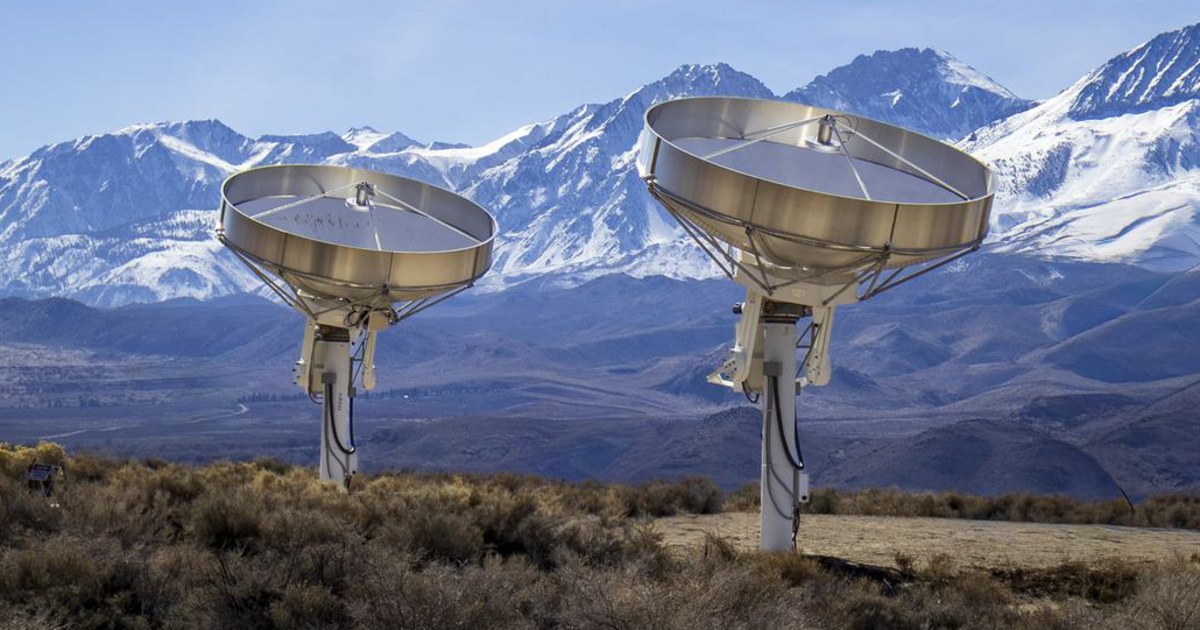
Nestled in the Great Basin, a remote stretch of the Nevada desert is set to become home to the world’s most sensitive radio telescope array.
Subscribe to read this story ad-free
Get unlimited access to ad-free articles and exclusive content.

The California Institute of Technology, which is leading the project, announced last week that it is moving ahead with the telescope’s construction after securing enough funding. Known as the Deep Synoptic Array, the project calls for 1,650 individual radio dishes that together will study supermassive black holes, spinning dead stars known as pulsars and fast radio bursts, which are brief, intense explosions of radio waves that often originate from deep space.
“It’s the sheer number of antennas that makes this completely unique and unlike other existing telescopes,” said Gregg Hallinan, a professor of astronomy at Caltech and a principal investigator for the Deep Synoptic Array.
Radio telescopes detect naturally occurring radio waves emitted by stars, planets, galaxies and other celestial objects. Astronomers can analyze the unique patterns of radio emissions from these sources to understand their structure, composition and other characteristics such as temperature.
Radio telescopes don’t snap photos in the same way as optical observatories, but the trove of resulting radio signals can be converted into data and turned into images.
Hallinan said that once built, the Deep Synoptic Array will outperform all other ground-based radio telescopes that came before it, surveying the sky 100 times faster and producing the highest-quality radio images to date.
“Every telescope that has been built in history — and that’s going back a century — combined has found about 20 million radio sources,” he said, referring to objects in space that emit radio waves. “That’s how many radio sources we know of in the universe. This telescope will double that in the first 24 hours.”
Each dish in the project is designed to measure roughly 20 feet across; taken together, they will form one of the largest radio telescope arrays ever built. It’s expected to span more than 123 square miles in Nevada’s White Pine County, in an area managed by the Bureau of Land Management.
Hallinan said the project is in the permitting process, and construction could begin next year, with the goal of wrapping up by 2029.
Typically, two types of telescopes are used for ground-based radio astronomy. One option is an enormous single dish like the Green Bank Telescope in West Virginia, which measures 328 feet across. The other is a vast array of smaller dishes such as the Very Large Array in New Mexico, which consists of 27 dishes in a Y-shaped pattern.
Single dishes tend to be more sensitive and able to pick up faint radio waves from deeper in the cosmos, but radio arrays with many dishes tend to capture much sharper images. Hallinan said the Deep Synoptic Array will be able to do both.

The Deep Synoptic Array is designed to pick up radio emissions from millions of stars, galaxies and other cosmic objects that emit blasts of radio light.
“Radio astronomy is about to go from sketch to photograph,” Vikram Ravi, a professor of astronomy at Caltech and a co-principal investigator for the Deep Synoptic Array, said in a statement. “The DSA is looking at a far larger volume of the universe far more often than any other telescope.”
Researchers plan to use the array to conduct at least five surveys of the sky, searching for tantalizing pulses of radio emissions that other observatories can then home in on for further investigation.
“We’ll be able to say precisely where in the sky we detected the radio source, and then all these other telescopes — optical, infrared and X-ray observatories — can point there,” Hallinan said.
Funding for the project came from Schmidt Sciences, a philanthropic organization created in 2024 by Eric Schmidt, the former CEO of Google, and his wife, Wendy. Schmidt last year became the CEO of the rocket company Relativity Space, which won a major NASA contract this week to deliver a set of the agency’s science instruments to Mars in 2028.
As an early step, Hallinan said, two prototype dishes were recently constructed near Bishop, California, as a technology demonstration.
To find a suitable home for the Deep Synoptic Array, he and his colleagues combed the western United States, surveying sites across California, Nevada, New Mexico and Utah. The ideal locations for such projects are remote and far away from radio frequency interference, such as from cellphone towers, Wi-Fi and other electronics.
“This telescope is sensitive enough to detect a cellphone as far away as the sun,” Hallinan said, “so we need to try to get away from all that.”
The Great Basin in Nevada turned out to offer a natural shield against pesky interference.
“There are these quiet valleys that are also very low in population,” he said. “This location in White Pine County was by far the quietest that we found, and it was just incredibly well-suited for radio astronomy.”
