

The big winners are anti-China hawks in the national security establishment and OpenAI and Anthropic.
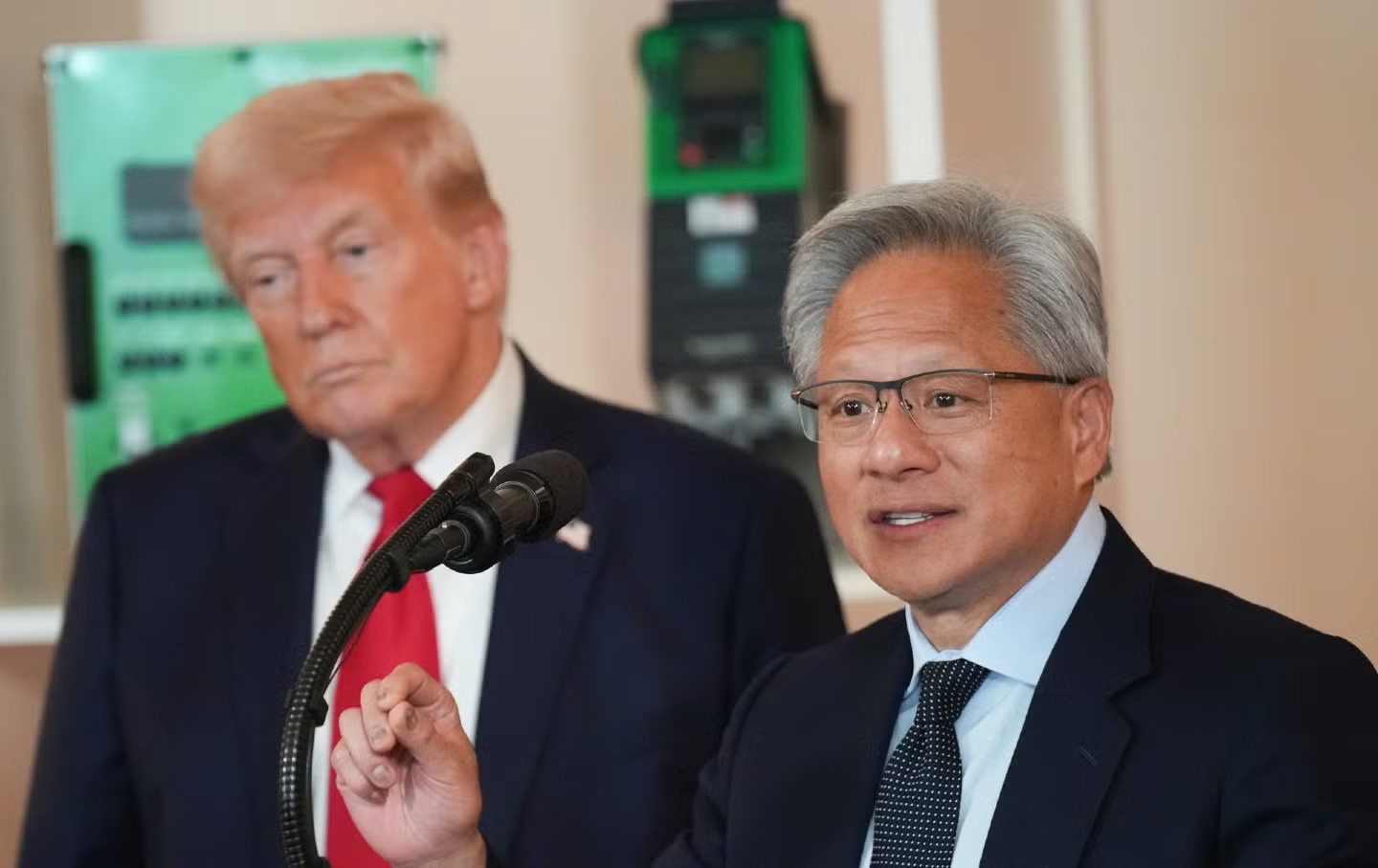
Last week, Jensen Huang resigned as CEO of chip giant Nvidia following a damaging news cycle focused on his affair with Alice Huang (no relation), widely referred to as an “alleged spy” for the Chinese government. It has since become unclear who exactly is alleging that Alice Huang is a spy or what exactly is meant by the word “spy”—but set that aside for now. What should progressives make of this?
It is understandable that some progressives have felt like cheering these developments. Jensen Huang is part of the AI oligarchy, and at long last one of them has been taken down a notch. But it would be a mistake to view Huang’s loss as a win for the people against the AI oligarchy as a whole. It is rather part of an intra-elite struggle that spans both Silicon Valley and Washington, DC. The major policy outcome is support from the Trump administration for tighter restrictions on the ability of Chinese AI firms to access Nvidia’s advanced chips. The big winners are anti-China hawks in the national security establishment and the frontier AI labs, OpenAI and Anthropic.
At issue is a growing convergence between the national security establishment and the AI industry. National security leaders hope that the US lead in advanced semiconductors and in frontier AI can yield an advantage in the arms race against China, helping to counter China’s edge in manufacturing capacity, while also boosting overall US economic growth, which can indirectly translate into military power. In turn, the national security establishment has much to offer the AI industry in the face of the latter’s increasingly pressing challenges: protection from rival Chinese AI firms on the grounds that their cheaper models are a national security threat, a potential source of bailouts through the Pentagon in the event that the AI boom turns to bust, and an ally against growing populist opposition within the United States.
Jensen Huang has been a leading obstacle to this convergence between AI and national security. This is because Huang’s position in US-China AI competition is uniquely contradictory: Nvidia’s profits come mainly from the US AI industry, which is entirely dependent on Nvidia’s advanced chips, but Nvidia also has the potential to earn major profits from AI companies in China. Indeed, if Nvidia were to gain the ability to sell directly in the Chinese market, it would be able to do so at premium prices. For OpenAI and Anthropic, in contrast, China’s AI firms pose a one-sided competitive threat.
Thus OpenAI and Anthropic have for the most part supported chip restrictions against China, while Nvidia’s Huang vigorously lobbied Trump to weaken those restrictions. Trump, who is independently interested in maintaining warm relations with Xi Jinping, was very responsive to Huang’s lobbying. As a result, the Trump administration allowed Nvidia both to continue supplying chips to data centers in third countries that service Chinese firms and to sell its (second-rate) H200 chips directly to China—although, ironically, China blocked imports of the H200 chips in order to protect demand for competing chips produced by Chinese firms.
Huang, for his part, argued that if Nvidia maintains a customer base in China, that is in the US national interest. For example, this would perpetuate Chinese dependence on US chip technology, which is a form of leverage, and Nvidia could invest profits from the Chinese market into further innovation, which would help maintain the lead of US technology over China’s. Whatever merit these arguments may have had, the national security establishment overwhelmingly rejected them.
Current Issue
National security leaders were accordingly frustrated that Trump listened to Huang and weakened anti-China chip restrictions. This is in turn part of a broader set of grievances that Trump has “caged the China hawks” in his administration. Marco Rubio, one of these hawks within the administration, is reported to have set the “alleged spy” scandal in motion. National security hawks across the political spectrum then successfully used the scandal as an opportunity to increase support for their desired chip restrictions, particularly within the administration, and to remove Huang as the leading obstacle to their agenda within Silicon Valley. At a time when national security arguments about the necessity of confrontation with China are declining in popular appeal, Huang was an exceptionally convenient target as an extraordinarily wealthy leader in the unpopular AI industry.
It is too little understood how damaging the US chip restrictions have been to the stability of US-China relations. Leaders in China (as in the United States) see advanced chips and AI as key to future economic development. During the Biden administration (which initiated the chip restrictions), the Chinese government denounced the chip restrictions in increasingly strident terms, culminating in the accusation that the United States is “containing China’s hi-tech development and depriving China of its legitimate right to development” and the statement that China’s “right to development” is one of its “four red lines,” alongside issues whose sensitivity is much better understood in the US, such as the “Taiwan question.” (The formulation of these “four red lines” has subsequently continued under Trump 2.)
The danger of the chip restrictions lies in the escalatory cycle they kicked off. China reacted by developing its own export controls on rare earth elements. This tool was activated following the intense escalation in the US-China trade war in 2025, leading to the October 2025 trade truce that Trump and Xi have sustained to this day. This Trump-Xi truce, however, is not a long-term solution to US-China tensions. The potential for China to cut off access to rare earths poses an existential threat to a few US industries, including arms manufacturers, which has of course further aggravated tensions on the US side. And this cycle of economic warfare creates new risks of US-China military conflict.
Seen in this context, there is little in Jensen Huang’s downfall, and the re-escalation in the chip war that it has enabled, for progressives to celebrate. But it doesn’t follow from this that progressive goals or the interests of the 99 percent can be won by siding with Huang. Rather, we need a way out of the intra-elite struggles between Silicon Valley and the national security establishment that brought down Huang. The real solution is to build a new US economy that isn’t dependent on AI as the sole source of growth, and a new approach to US security that provides an alternative to zero-sum tech-military-industrial competition against China.
